

WHAT WE DO
Atrial Flutter (AFL) Treatment
Atrial flutter is another common arrhythmia. While the impulse starts in the atrium, rather than travelling to the AV node and then on to the ventricles, a type of “short circuit” develops. This results in a circular electrical pathway which may allow the electrical impulse to quickly move around the right atrium, at as much as 300 times per minute. This results in the impulse travelling around the atrium more than once before the signal reaches the AV node for conduction down to the ventricles. Patients with atrial flutter may experience heart rates of up to 150 bpm. So unlike A Fib which is characterised by being fast and irregular, atrial flutter is often fast but regular.
Atrial flutter, like A Fib, is important as it increases the patient’s risk of stroke, permanent disability or heart failure.
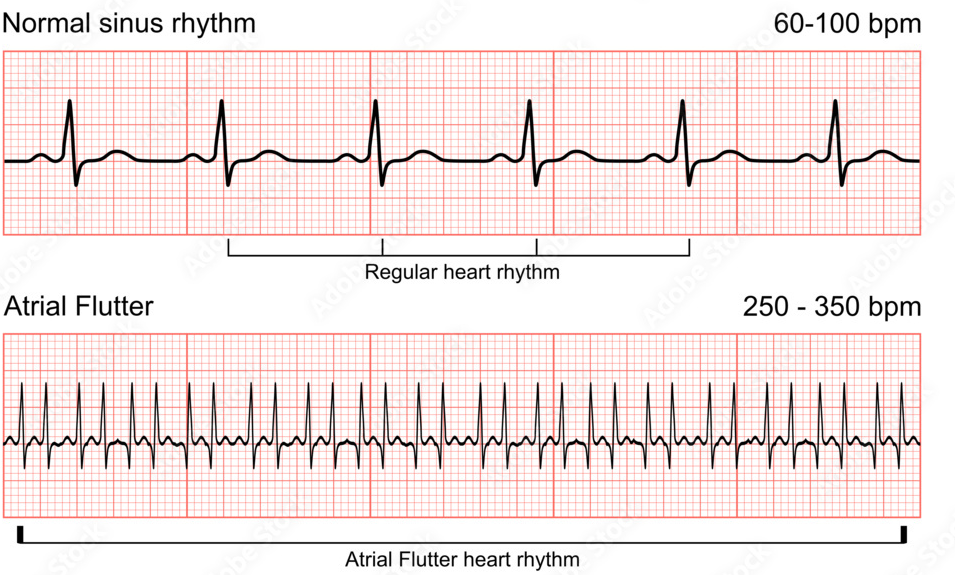
Atrial flutter can be classified in two ways; depending on the location of the short circuit:
- Typical atrial flutter: the arrhythmia is localized to the right atrium, it uses the area of the Inferior Vena Cava vein and Tricuspid annulus as part of its circuit and usually travels in an anticlockwise direction.
- Atypical atrial flutter: may, but doesn’t always, arise in the left atrium. When performing an ablation of an atypical flutter, the procedure may take a little longer than for a typical atrial flutter.

Symptoms of atrial flutter are similar to those of A Fib and include:
- Feelings of a fast, fluttering or pounding heartbeat, called palpitations.
- Chest pain.
- Dizziness.
- Fatigue.
- Light-headedness.
- Reduced ability to exercise.
- Shortness of breath.
- Weakness.
For more information visit:
https://www.mayoclinic.org/tests-procedures/atrial-fibrillation-ablation/dr-adele-greyling-electrophysiologist-and-paediatric-cardiologist/pac-20384969 ECG
ECG